Evil Apples: Play Dirty
- 4.5
- Rating
- 5.00M
- Installs
- Free
- Price

 Analysis by App-foxy
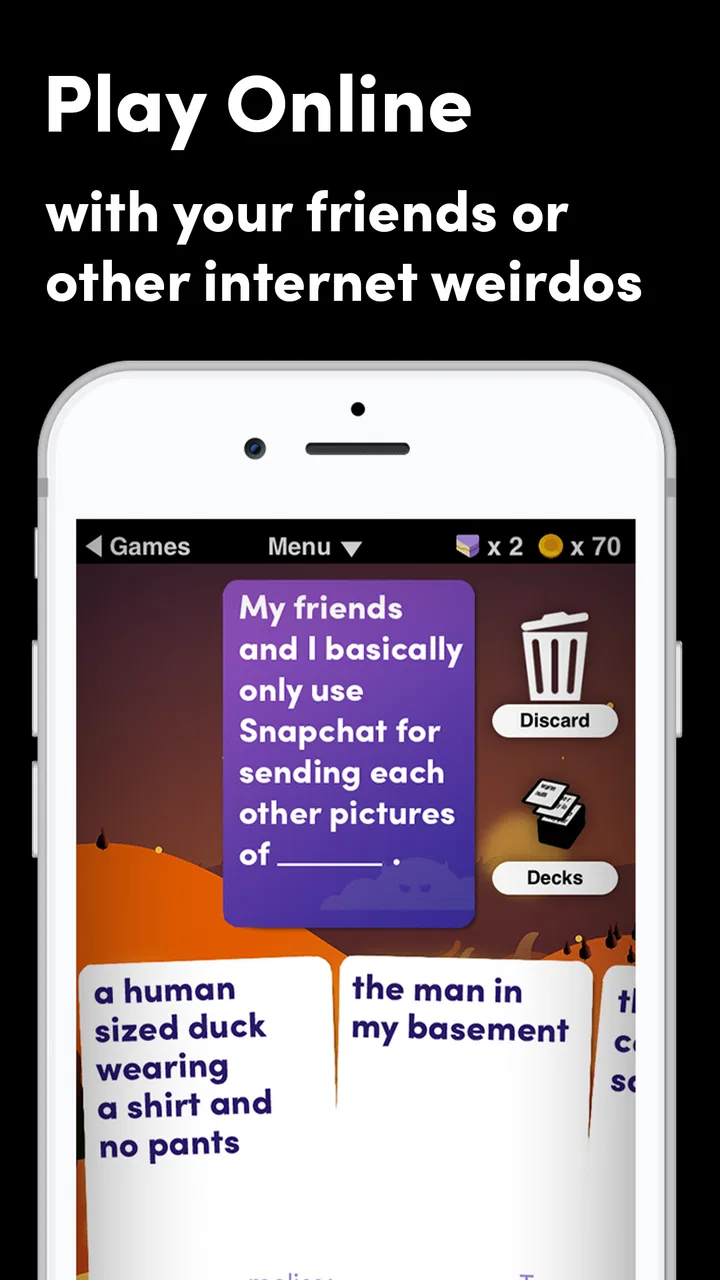
Some party games are fun because they are clever, while others work because they make a room lose its composure. Evil Apples: Play Dirty belongs firmly in the second group. I found it easiest to enjoy when everyone already understood that the goal was not tasteful wordplay but the funniest, most inappropriate, or most unexpected response at the table. It is a free word game from Super Massive Ventures Inc., built around a large collection of cards and wild prompts, with a Teen content rating that accurately signals the kind of humor involved.
My first impression was strong because the basic idea is immediately understandable. A prompt appears, players choose a response, and the group reacts to the combinations. That simple structure makes it a natural choice for a casual gathering where nobody wants to spend half an hour learning rules. It also explains why the game has attracted over five million installs and an average rating of 4.5 from around 157 thousand ratings. Those figures suggest a broad audience, but they do not guarantee that every group will enjoy the tone. In my experience, the people around the screen matter more than the game itself.
Why the first week feels so easy to enjoy
The opening sessions are carried by surprise. Even when a card is not especially funny on its own, placing it beside a strange prompt can create a memorable combination. That unpredictability gives the game a useful advantage over many conventional word puzzles: I am not playing only to find the “correct” answer. I am trying to anticipate what will make this particular group laugh, cringe, or argue over the best choice.
You May Also Like

 Blood Strike: 2.5 Anniversary
Blood Strike’s Loadouts Turn Every Drop Into a Tactical Gamble
A close look at Blood Strike’s custom loadouts: how fast access to signature weapons reshapes its battle royale rhythm, rewards preparation, and narrows the gap between fights.

 Pandora - Music & Podcasts
Pandora’s Music Is Easy to Start, but Harder to Recover
Pandora’s strength is its low-effort path from a seed to a station. Its weak spot is how much confidence it asks you to place in connection, setup, and quiet recovery.

 8 Ball Pool
 Is Built on Rivalries, Rematches, and Routine
A close look at the rivalries, rematches, shared routines, and unanswered safety questions that turn a quick pool match into a persistent mobile community.

 Samsung Music
’s Quiet Strength Is Playing What You Already Own
Its reach comes less from spectacle than from dependable access to a personal library. That simplicity is both the app’s strongest retention engine and its ceiling.

 AccuWeather: Weather Radar
AccuWeather Review: A Quick, Clear Forecast for Everyday Decisions
For everyday plans, the best forecast is the one you can understand quickly. AccuWeather makes rain timing, radar, and local conditions easy to act on, with a few trade-offs.

 Hill Climb Racing
Why Hill Climb Racing Still Turns Crashes Into One More Run
A tiny car, a bumpy hill and one more upgrade: Hill Climb Racing keeps resurfacing because its simple chaos makes every near-miss feel personal.
More From Our News Desk



That social guessing is the real hook. A response that would be weak with one group may win instantly with another because it matches an inside joke, a shared habit, or somebody’s personality. I noticed that the game became more entertaining once players stopped choosing cards they personally liked and started choosing cards that suited the person judging the round. That small change turns a basic card selection task into a light exercise in reading the room.
The large card pool also helps the early experience feel varied. The store summary describes more than eight thousand cards and wild prompts, and that scale gives new players plenty to discover. I would not treat the number as a promise that every card will be brilliant. A collection this broad naturally includes material that feels obvious, repetitive, or dependent on a very specific sense of humor. Still, during the first few gatherings, the volume makes it unlikely that the group will run out of things to react to.
A realistic use case is a group of friends waiting for food, sitting together after a movie, or filling an awkward gap at a small party. One person can introduce the game without preparing a board, score sheet, or complicated explanation. The best results come when everyone is willing to contribute energy rather than stare silently at the screen. If the group is already chatting, the cards give that conversation a direction. If nobody wants to perform socially, the game cannot manufacture enthusiasm by itself.
I also think the Teen rating deserves practical attention rather than being treated as a minor label. The humor is intentionally dirty, and that can be exactly the reason adults choose it for a private gathering. It also means I would not casually open it around children, at work, or with relatives whose boundaries I do not know. The game is not a general family word game with a slightly cheeky edge; its identity depends on adult-oriented material.
The first sessions reward the right group, not the biggest group
In my testing, a smaller, familiar circle produced better rounds than a large collection of people who barely knew one another. Familiar players understand each other’s humor and can make bolder choices without needing to explain every reference. A mixed group can still work, but it benefits from agreeing on the tone before starting. That one-minute conversation prevents the common problem where one person thinks the game is harmless silliness and another feels ambushed by the content.
Compared with a traditional crossword or a solo word puzzle, this is less about vocabulary and more about timing, taste, and social awareness. Compared with a standard board-based party game, it is easier to start because the phone handles the card flow. The trade-off is that the device becomes part of the social space. If players dislike passing a phone around or prefer physical cards on a table, a boxed alternative may feel warmer and more immediate.
Another early strength is the low financial barrier. The game is free to download, which makes it easy to suggest without asking a group to buy a shared product first. There are in-app purchases ranging from $0.99 to $99.99 per item, so I would approach optional spending carefully. The free starting point is useful for testing whether your friends even enjoy this style of humor before investing anything.
What remains useful after the novelty wears off
The important question is not whether the first evening is funny. Most party games can manage that. The better test is whether people still want to open the game after the obvious jokes have been seen. For me, the answer depends on rotation. If the same people play the same way every time, the experience can become predictable. If the group changes, or players deliberately alter how they judge and select responses, the game has a better chance of staying in the routine.
Its recurring value comes from social variation rather than from deep personal progression. I did not approach it as a game that rewards long solo practice or steadily improves a measurable skill. Instead, each gathering creates a new context. A card that failed last week may work later because the group has a new story to connect it with. That makes the game more reusable than its individual jokes might suggest, but it also means the app cannot carry a gathering where the players are disengaged.
For regular use, I recommend treating it as a short activity rather than the entire evening. A few rounds can energize a conversation, while a long uninterrupted session increases the chance that the humor starts feeling mechanical. This is one of the less obvious ways to preserve its value: stop while people are still laughing. Waiting until everyone is bored makes the game seem more repetitive than it needs to be.
Another useful habit is to change who gets the most attention. Some groups naturally let the loudest person dominate the reaction to every card. That can flatten the experience because quieter players stop feeling that their choices matter. I found the rounds more balanced when everyone had room to explain a choice or defend why a particular answer fit the prompt. The game does not need a formal house-rule system for this; a little social management is enough.
That is also where it differs from solo word games. A crossword, an anagram app, or a daily vocabulary challenge can become a personal habit because progress belongs entirely to the individual. Evil Apples is more like a reusable social tool. Its lasting space is beside a group chat, a casual meetup, or a party plan—not necessarily on the home screen for someone who usually plays alone.
How to keep repeated sessions from feeling identical
I would avoid using it as the only activity at every gathering. Pairing it with conversation, snacks, or another kind of game gives the rounds a natural beginning and end. It also helps to invite people with different personalities. A group that always chooses the safest possible answer will exhaust the game faster than one that enjoys taking risks within agreed boundaries.
There is a practical distinction between replayability and freshness here. Replayability means the game can be used again; freshness means it still feels surprising. The large library supports the first, while the players determine the second. If you are considering it for a recurring event, such as a weekly friend meetup, I would expect the strongest results when attendance changes from week to week or when the group takes breaks between sessions.
The game can also work as an icebreaker, but only after a little care. With strangers, the dirty humor may reveal too much too soon. In that setting, a cleaner word game or a cooperative trivia app is usually a safer choice. With established friends, however, the same directness removes awkwardness and gives everyone an immediate subject to react to.
The maintenance burden is mostly social
From a practical standpoint, the game is easy to keep available. It is free, supports devices running at least iOS or Android equivalent version 8.0, and its current version is 5.7.32. Those details make it accessible on older supported phones rather than limiting it to recent hardware. I would still keep the app updated when possible, especially if a group relies on it for occasional events, because party games are most frustrating when they are opened only to discover that the installed version needs attention.
The bigger maintenance task is managing expectations. Before starting, I would tell new players that the content is deliberately adult and that the humor may be crude. This avoids wasting the first round on people trying to work out whether the tone is serious. It is also worth agreeing that anyone can skip a prompt or step away without having to justify the decision. That is not a criticism of the app; it is a sensible way to use a game whose appeal depends on provocative material.
In-app purchases are another part of the maintenance question. The free entry point makes experimentation simple, but the presence of purchases from $0.99 to $99.99 per item means I would not hand the device to a child or leave buying decisions vague during a party. If the group is satisfied with the available content, there is no reason to spend merely because additional material exists. I see optional purchases as something to consider only after the game has proved useful for your particular circle.
The developer, Super Massive Ventures Inc., has kept the title active enough to have a current version associated with it, which is reassuring for a game people may return to between gatherings. Still, an active app is not the same as a maintenance-free experience. Phones change, operating systems change, and the social group can change faster than either. I would judge the app by whether it remains convenient for your friends, not by whether it becomes a permanent daily habit.
Where fatigue starts to appear
The main source of fatigue is tonal repetition. Dirty humor can be exciting when it catches the group off guard, but repeated exposure reduces the shock. Once players understand the broad patterns of the cards, some rounds begin to feel like variations on a familiar joke. The extensive collection delays that problem; it does not eliminate it.
A second weakness is the dependence on the judge or decision-maker. If that person consistently rewards one type of answer, everyone learns to play toward the same reaction. The game then becomes less about creative combinations and more about guessing a predictable preference. Rotating the judging role is therefore more than a fairness gesture—it is a way to refresh the strategy and keep different styles of humor in play.
I also found that the app is less satisfying for people who want structured competition. A word game with a clear score, visible progression, or individual improvement gives players a reason to return alone. Here, the reward is the shared moment. If you want to train vocabulary, solve increasingly difficult challenges, or compare precise performance, this is probably the wrong category of game for you.
Device dependence can create friction too. A physical card game places the material in the middle of the table, while a phone can pull attention toward its notifications, battery level, or other apps. I would put the device on a table or pass it deliberately rather than letting one person quietly control everything. That small choice makes the gathering feel more like a group activity and less like one person operating entertainment for everyone else.
There is also a boundary issue that should not be minimized. The Teen rating makes the intended audience clear, but a rating cannot predict the comfort level of a specific group. Some friends may love outrageous prompts; others may prefer clever, absurd, or family-friendly humor. If your group’s tastes are mixed, a general party game with adjustable content is likely to be a better fit. This title is strongest when nobody has to apologize for the basic premise.
Who should install it, and who should pass
I would recommend it to adults who want a quick, irreverent group game and already have friends willing to joke openly. It is especially suitable when you need something with almost no preparation, when the group enjoys judging each other’s sense of humor, or when a conventional board game would feel too formal. The free price makes it a sensible trial for a planned gathering.
I would skip it if you mainly play alone, need clean content, dislike crude jokes, or want a game that rewards careful word knowledge. I would also choose a different option for professional team events, family gatherings with children, or groups that are still learning each other’s boundaries. In those situations, the app’s defining strength becomes its biggest liability.
For someone deciding whether to keep it installed, I would ask one simple question: do your friends create new energy around the prompts? If yes, the app can earn a recurring place because the people provide the variety. If no, a larger card pool will only postpone the same disappointment. The game is not a substitute for chemistry; it is a way to give chemistry something to work with.
My long-term verdict
After the first-week excitement, Evil Apples: Play Dirty becomes less about discovering cards and more about maintaining the right social conditions. That is both its limitation and its lasting advantage. It does not offer the solitary satisfaction of a daily word puzzle, nor the tactile presence of a physical card deck. What it offers is fast access to deliberately unruly group humor, with enough material to support repeated gatherings when the players keep changing the rhythm.
I appreciate that it is free to try, easy to explain, and honest about its adult tone through the Teen rating. The broad library gives new groups plenty of room to find their style, while the current version and support for older operating systems make it a practical option for casual use. I would remain cautious around optional purchases, and I would not mistake the high rating or large audience for proof that every friend group will connect with it.
My final recommendation is conditional but positive: keep it installed if you host relaxed gatherings, enjoy dark or dirty humor, and are willing to manage the pace and boundaries yourself. Use it in bursts, rotate the judge, and stop before the jokes become routine. Its real long-term value comes from the people playing, not from endless novelty. For the right circle, that is enough to make it a dependable party companion. For everyone else, a cleaner or more structured word game will probably deserve the lasting space instead.
FAQs for Evil Apples: Play Dirty
01What is Evil Apples: Play Dirty?
Evil Apples: Play Dirty is a humorous, adult-oriented party card game for Android and iOS. It follows a Cards Against Humanity-style format: one player presents a question or sentence, while everyone else submits the funniest, strangest, or most inappropriate answer. The game is designed for group play, but you can also join online matches with other players. Its comedy is intentionally edgy, so it may not suit children or players who prefer family-friendly content.
02Can I play Evil Apples: Play Dirty with friends online?
Yes, the game is primarily built around multiplayer sessions and allows you to play with friends remotely or participate in games with other users. You can typically invite people into a match and take turns judging the submitted answers. The experience is more enjoyable when everyone understands the rules and humor style beforehand. Because online features can change with updates, availability may depend on the current version, region, and the developer’s active servers.
03Is Evil Apples: Play Dirty appropriate for children?
No, Evil Apples: Play Dirty is intended for mature audiences. Its cards and player-submitted content can include profanity, sexual references, dark humor, and other subjects that may be unsuitable for minors. The game’s appeal comes from its deliberately provocative comedy rather than its educational or family-friendly design. Parents should review the store rating, privacy settings, and multiplayer options before allowing a teenager to download it, and younger children should not use it.
04Does Evil Apples: Play Dirty require an internet connection?
An internet connection is generally needed for the main multiplayer experience, including creating or joining online games, synchronizing content, and interacting with other players. Playing offline may be limited or unavailable depending on the current app version. A stable connection is recommended because interruptions can affect turns, matchmaking, or game progress. If you plan to play while traveling, check the app after installation to see which features remain accessible without Wi-Fi or mobile data.
05Is Evil Apples: Play Dirty free to download and does it contain in-app purchases?
Evil Apples: Play Dirty can generally be downloaded without an upfront purchase, but free access may be supported by advertising, optional purchases, or additional content. Depending on the platform and version, players may encounter paid card packs, premium features, or other in-app offers. Before downloading, review the Google Play or App Store listing for the latest pricing details. If children use the device, enable purchase restrictions to prevent accidental transactions.
Pros
- Easy-to-learn rules make it accessible for casual players.
- Large card library keeps matches varied and unpredictable.
- Private rooms let you play with friends or family.
- Quick rounds fit well into short gaming sessions.
- Humor and mature themes appeal to adult party-game fans.
Cons
- Some jokes may feel offensive or uncomfortable for certain players.
- The game depends heavily on having enough active players online.
- Many features and card packs require in-app purchases.
- Match quality can vary when playing with random opponents.
- Frequent notifications may become distracting without adjustment.

Evil Apples: Play Dirty
Gallery